
Inclusive and Relatable Physics Practice Problems
So you can feel like you belong in physics
Practice Problems
One-Dimensional Kinematics
One trip at constant/average velocity v = ∆x/∆t
Sofia hates her braces, but her orthodontist is pleased that one of Sofia’s molars has moved straight forward 1.2 mm since her last appointment 29 days ago. What was the average velocity (in SI units) of the tooth during that time?
written by Allison Boley
About
Hello and welcome to a preview of our Inclusive and Relatable Physics Practice Problem website!
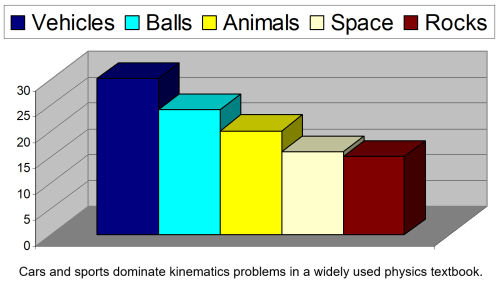
I'm Allison Boley, an Associate Teaching Professor here at ASU, and when I was an introductory student, I noticed how little of my physics homework seemed to be written with someone like me in mind. Understanding that I was not part of the target audience, I felt like I didn't belong in this environment with so much attention on the physics of cars, sports, traditionally masculine chores, and violence.
My personal feelings aside, I recognized that such an unnecessarily narrow focus also limits students' exposure to the endless applications of physics.
When I got my own classroom in 2015, I started writing all my own problems. The longer I taught, the more I learned how to write problems that related not only to my everyday life, but also to my students' lives. Over the years, I wrote about the periodic motion of rocking a baby to sleep, the distance and displacement of a drumstick hitting a snare drum, the force to push a sibling across the carpet in a laundry basket, and more.
But it's not enough. I'm one person with one set of identities and one set of experiences. To truly construct a relatable problem set, we need a team.
That's the plan here. With a bit of initial funding, a core team of Assistant Teaching Professor Julia Doelger, several physics and engineering students, and me are writing problems from our own lived experiences and observations. Other ASU physics students are contributing a problem or two of their own as volunteers, and some ASU students outside of STEM will be contributing ideas from their lives which our team will then turn into problems. After university fees, 85% of our spending goes toward paying students.
We want everyone to feel like they belong here. That doesn't mean every problem will relate to your life. It means we want you to see yourself and your life reflected in some problems, and to expand your curiosity and understanding of physics by seeing other people and their lives reflected in other problems.
In time, this website will offer hundreds of problems across many areas of introductory physics. For now, please enjoy this preview of ~150 problems across one-dimensional kinematics and electrostatics.
Teachers, please feel free to use any of these problems in your class. We ask that you credit the writer of the problem as well as our website. If you use a problem for an assessment, feel free to slightly change numbers or switch which is the varible for which students must solve.
Our Team
Current Physics/Engineering Contributors | Past (Graduated) Physics/Engineering Contributors | Contributors Outside of STEM |
|---|---|---|
Allison Boley (Physics, Associate Teaching Professor) | Ash Cain (Physics, BS) | Peyton Greer (Counseling, Graduate Student) |
| Julia Doelger (Physics, Assistant Teaching Professor) | Bella Tuffias-Mora (Physics, BS, and Environmental Studies, BA*) *Oberlin College of Arts and Sciences | Hannah Frazier (Music Therapy, Undergraduate Student) |
| Daniel Tang (Biophysics, Biochemistry, and Spanish, Undergraduate Student) | Jesse Kunz (Physics, BS, and Mathematics, BS) | Malena Martinez (Music Therapy, Undergraduate Student) |
| Adii Abhishek Singh (Applied Physics, Undergraduate Student) | Steven Martinez (Physics, PhD) | Cecily Milynn (Art, Undergraduate Student) |
| Natasha Forrand (Physics, Graduate Student) | Maanesh Mohanraj (Data Science, MS) | Kalvin Chavez (Transborder Studies and Sociology, Undergraduate Student) |
| Emmanuel Alcantar (Physics and Mathematics, Undergraduate Student) | Cas Smith (Astrophysics, BS) | |
| Leslie Rurangwa (Biomedical Engineering, Undergraduate Student) | ||
| Sajal Dahal (Physics, Graduate Student) | ||
| Apollo Pigon (Biophysics and Astrophysics, Undergraduate Student) | ||
| Zoe Bonasera (Physics, Graduate Student) | ||
| Meghana Baladari (Data Science, Analytics and Engineering, Graduate Student) | ||
| Isabelle Widener (Physics, Undergraduate Student) | ||
| Cyros Holmes (Physics, Undergraduate Student) |
All affiliations are Arizona State University unless stated otherwise.
Notation
One-Dimensional Kinematics
| t - time |
| Δt - change in time |
| xi or yi - initial position |
| xf or yf - final position |
| Δx or Δy - distance/displacement |
| ∆xdist - distance |
| ∆xdisp or ∆x - displacement (when distance and displacement are present in the same problem, bold indicates displacement) |
| v - speed/velocity |
| vi - initial speed/velocity |
| vf - final speed/velocity |
| vavg - average speed/velocity |
| Δv - change in speed/velocity |
| vavg - average velocity (when both speed and velocity are present in the same problem, bold indicates velocity) |
| a - acceleration |
| g - acceleration of gravity (g = 9.8 m/s2) |
Angular Kinematics
| θ - angular position |
| ∆θ - angular displacement |
| θi - initial angular position |
| θf - final angular position |
| ω - angular speed/velocity |
| ωi - initial angular speed/velocity |
| ωf - final angular speed/velocity |
| v - linear velocity |
| α - angular acceleration |
| a - linear acceleration |
| r - radius |
| s - arclength |
| other quantities are as defined in previous section(s) |
One-Dimensional Electrostatics
| q - charge |
| e - elementary charge |
| F - force |
| k - Coulomb's constant (k = 8.99 x 10⁹ N*m2/C2) |
| r - distance between charges |
| E - electric field |
| p - dipole moment |
| d - distance (depends on context: may be distance traveled, distance between poles of a dipole, etc) |
| V - electric potential |
| U - potential energy |
| other quantities are as defined in previous section(s) |